
I was worried earlier this winter when all of my smaller-leafed rhododendrons had turned burgandy and curled up tightly. Had I killed them by pruning them too deeply after they flowered last year?
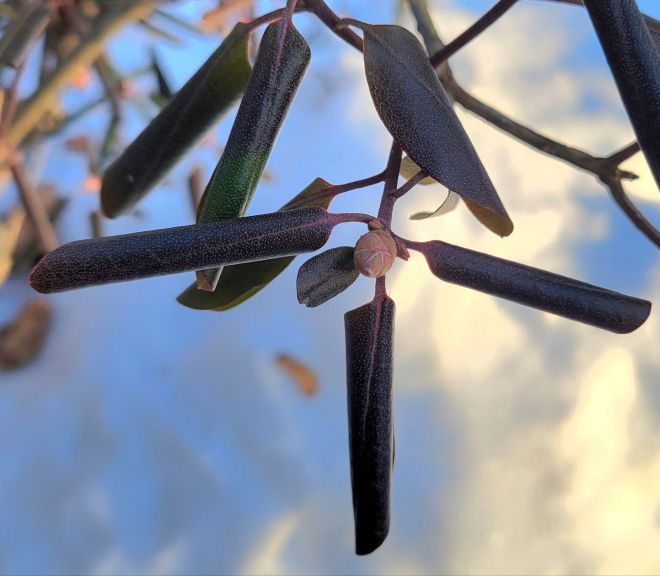
I’ve written before about senescence, in which the rhodies’ older leaves turn yellow and fall off in the autumn. Even the evergreens lose their leaves and needles sometimes!
But all brownish and shriveled up, these poor leaves look dead.
I am happy to report that they are not, in fact, dead. The temperature was 22°F (-5°C) this morning when I took that sad-looking picture above. But yesterday it was in the mid-30s (~2°C) when the same leaves looked like this:

What’s going on out there? There are two processes at work: thermonasty, and what Native Plant Designs, Inc. calls chromoplasticity.
Thermonasty
Just look at the word, and you can tell what it means: nasty temperatures! A peek out the window at the rhodie tells us how cold it is outside. Do we need to grab a hat and gloves on the way out the door, or will a sweatshirt do?
Rhododendron leaves curl up tightly in response to frigid temperatures. This reduces the surface area of the leaves facing the sun, protecting them from exposure damage. It also reduces the snow weight they can hold, lessening stress on the branches.
Chromoplasticity
This one’s a little less obvious to me, but perhaps you’ve figured it out already! Color changes in the leaves adapt to the seasons.
Green leaves churn out energy through photosynthesis using the sun’s energy, mostly from the blue and red sections of the light spectrum. They’re green because that’s what’s reflected out instead of being absorbed and used.
Blue light is important for growth, root development, and leaf formation (not needed in the winter), and red light promotes fruit production (in our case, lovely flowers, and not good for winter temperatures!). Check out this handy dandy writeup on the light needs of leafy vegetables for more information.
Enzymes critical to this process slow down in colder temperatures, and the light energy from the sun can cause damage to the very food factories that use that energy. In essence, the leaves put on sunscreen in the form of a color change!
Instead of absorbing those red and blue wavelengths, they go after the green light and reflect the red and blue. Red+blue=purple (or burgandy). Here’s another resource to browse through: Rhodoxanthin Writeup.
The more leaf surface facing the sunlight, the deeper the color change. That means the underside of the leaf usually stays green because it’s already shaded from above.
I took a picture of the underside of the leaves to show that they are, in fact, still green and alive!

Rhodie Lessons for Life
Just as the rhododendrons in my yard are affected by the seasons, so are our spiritual lives. We all go through different seasons, multiple times throughout our years on the earth.
Some seasons are full of life, filled with activity and growth. We grow deeper in our faith and closer in our relationships with God and others. Life is bursting with sunshine on the outside and joy on the inside!
Other seasons are dark and lonely. We feel disconnected from God and can’t seem to make any real connection with anyone else. It’s hard to find a ray of light anywhere, and joy seems like an ethereal concept that simply can’t be grasped.
Still other seasons are stifling, and we feel oppressed by too many demands on our limited resources of time, mental capacity, and emotional reserves. We start to get angry, lashing out at the pressures we feel from every side.
Might I suggest that we not try to fight the seasons? Just as the rhodie can’t change the earth’s relationship to the sun, we can’t wish our seasons away. Perhaps we can find ways to make small adjustments within our hearts and minds (and even bodies) to help us adapt to what we cannot change. On the other hand, when the season is good, it’s time to soak it in and be as present in the present as possible!
I’ll share a few small things that have helped me through rough seasons.
We are complex creations, even more so than the rhododendron! We are spirit, mind, and body. All three work closely together, depending on one another like a three-legged stool. When we’re sick, it’s hard to think, and we’ve no energy to do what we need to do. When we’re stressed, our body wants sugar to help the mind feel good. Having either mind or body out of line affects our spirit’s ability to hear from God.
If I’m out of whack in one arena, it could be because I’m unbalanced in another!
Here we go . . .
- Exercise, even just a few minutes at a time! Negative energy gets an outlet as I speedwalk through the grocery store or parking lot, or quickly carry the trash out to the bin. I try to fit resistance training in almost every morning, but I understand that some schedules are simply too tight for that.
A growing body of research suggests physical fitness is one way to boost brain health — and that a regular exercise routine can decrease the effects of stress on the body, improve mental health and mood, and even enhance memory and cognition.
- Journaling gets things out of my mind and onto paper. I journal my prayers in the morning, including things I’m grateful for. That helps me remember that God is for me, is working in my life, and is still blessing me even when I’m not feeling it!
If I’ve had a particularly rough day, I journal my angst into a gripe journal just to get my thoughts out of my own head. Somehow writing down what I’m mentally wrestling with helps me let it go enough to get to sleep.
- Building routine decreases the number of decisions I have to make throughout the day, reducing my mental workload. I don’t have to think about what to do when I get up, because the schedule’s pretty well set. I’ve got a morning routine and an evening routine. The middle of the day is for everything else!
- Making connections with others in my community and with my interests lightens my mood. Whether it’s building relationships at church or getting to know friends in town, getting rooted in the neighborhood helps bring a feeling of stability.
- Serving others, mainly hikers on their way through town, is good for my soul! It makes me happy and combats any stress, anger, and anxiety I’m experiencing.
- Blogging energizes me! Can’t figure that one out, but here we are!
Does even one of these seem like a possible help for where you are right now? Which one might you squeeze into your daily life?
Do you have any small adjustments you’ve learned make big dividends in how you weather your life seasons? I’d love to hear about them in the comments below!
 Lauri Hawley
I love this!
LikeLiked by 1 person
Thank you! Creation never ceases to amaze, and God can teach us so much through it ❤️
LikeLiked by 1 person